Practical · 7 min read
What is spray cork?
A plain-English explanation of what spray cork is, what it's made from, how the material is produced, where it can be used and how installers apply it.
Last updated

Spray cork is a thick, flexible exterior wall coating made from granulated cork bark suspended in a water-based resin. It is sprayed onto walls rather than trowelled on, and cures into a seamless, slightly textured skin a few millimetres thick.
This guide explains what the material actually is, how it is produced, where it can be used and what happens on site during an installation.
What the material is made from
The cork itself comes from the bark of the cork oak (Quercus suber), grown mainly in Portugal and Spain. The bark is stripped by hand roughly every nine years and grows back, so the tree is not felled — this is why cork is described as a renewable material.
Cork's cell structure is made up of millions of sealed air pockets. That is what gives it its low density, its insulating behaviour, its elasticity and its resistance to water absorption.
- Cork granules — typically recycled or by-product cork, graded by particle size
- A water-based acrylic or elastomeric resin binder
- Pigments for colour, plus additives for UV stability, adhesion and mould resistance
How spray cork is made
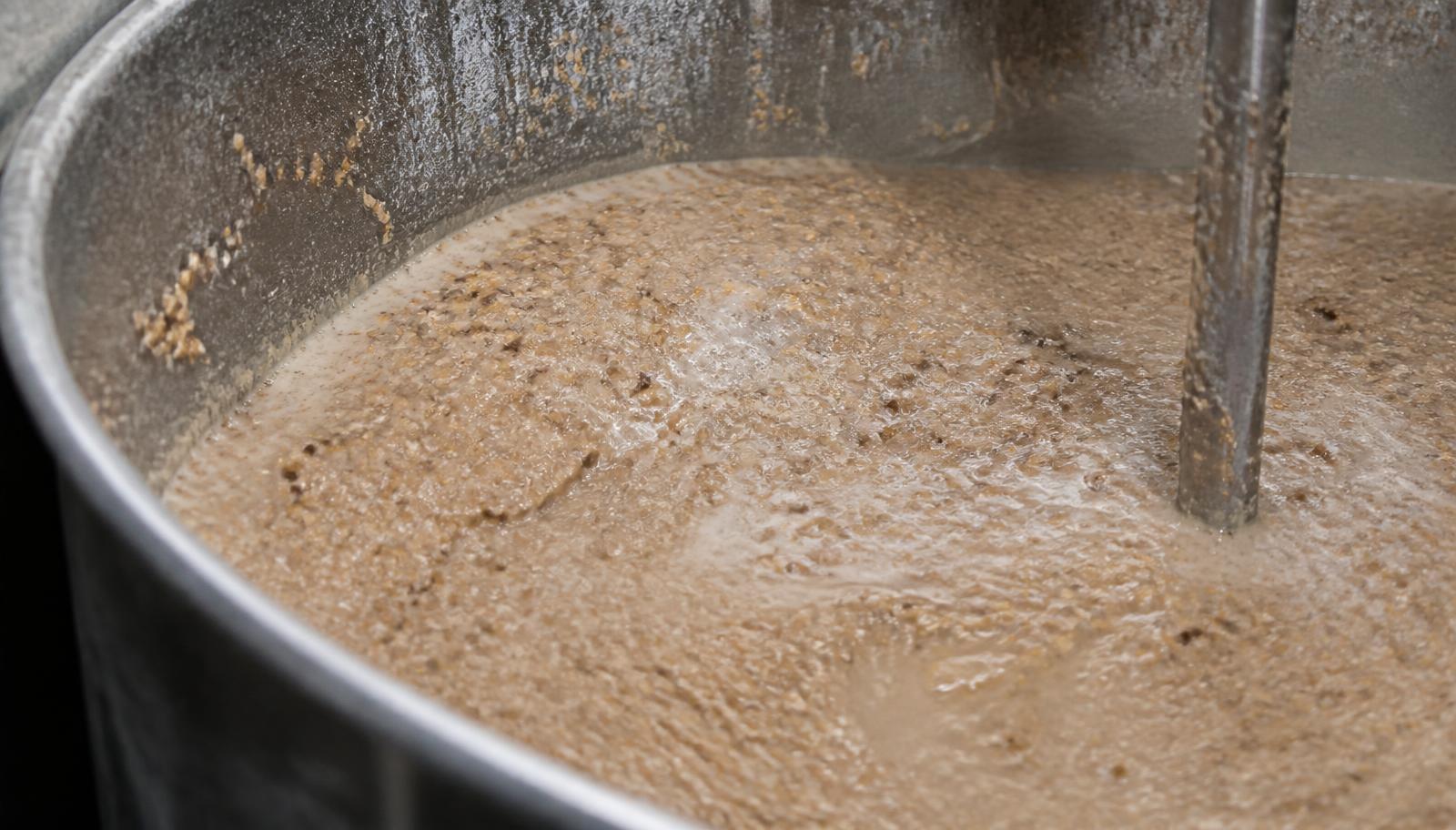
Harvested bark is boiled, dried and ground into granules. Those granules are graded — finer grades give a smoother finish, coarser grades a more pronounced texture — and then blended with the resin, pigment and additives into a thick paste.
The result is supplied in tubs, ready mixed and tinted to a chosen colour. Different manufacturers use different cork-to-binder ratios and different binder chemistry, which is why performance claims vary between products. Ask any installer for the technical data sheet of the specific product they intend to use.
Where it can be used

Most UK work is external: house elevations over brick, render, pebbledash, concrete, block or existing sound masonry paint. It is also used on garden walls, garages, dormers, soffits, conservatory bases and flat roof upstands.
It is not a structural repair and it is not a damp-proof course. Walls with penetrating damp, failed pointing, cracked render or a broken DPC must be fixed first — a coating over an unresolved defect just hides it.
- Suitable substrates: sound brick, render, pebbledash, stone, concrete and block
- Also used internally on feature walls for its acoustic and warm-touch qualities
- Not a substitute for structural repair, damp remediation or certified external wall insulation
How it is installed
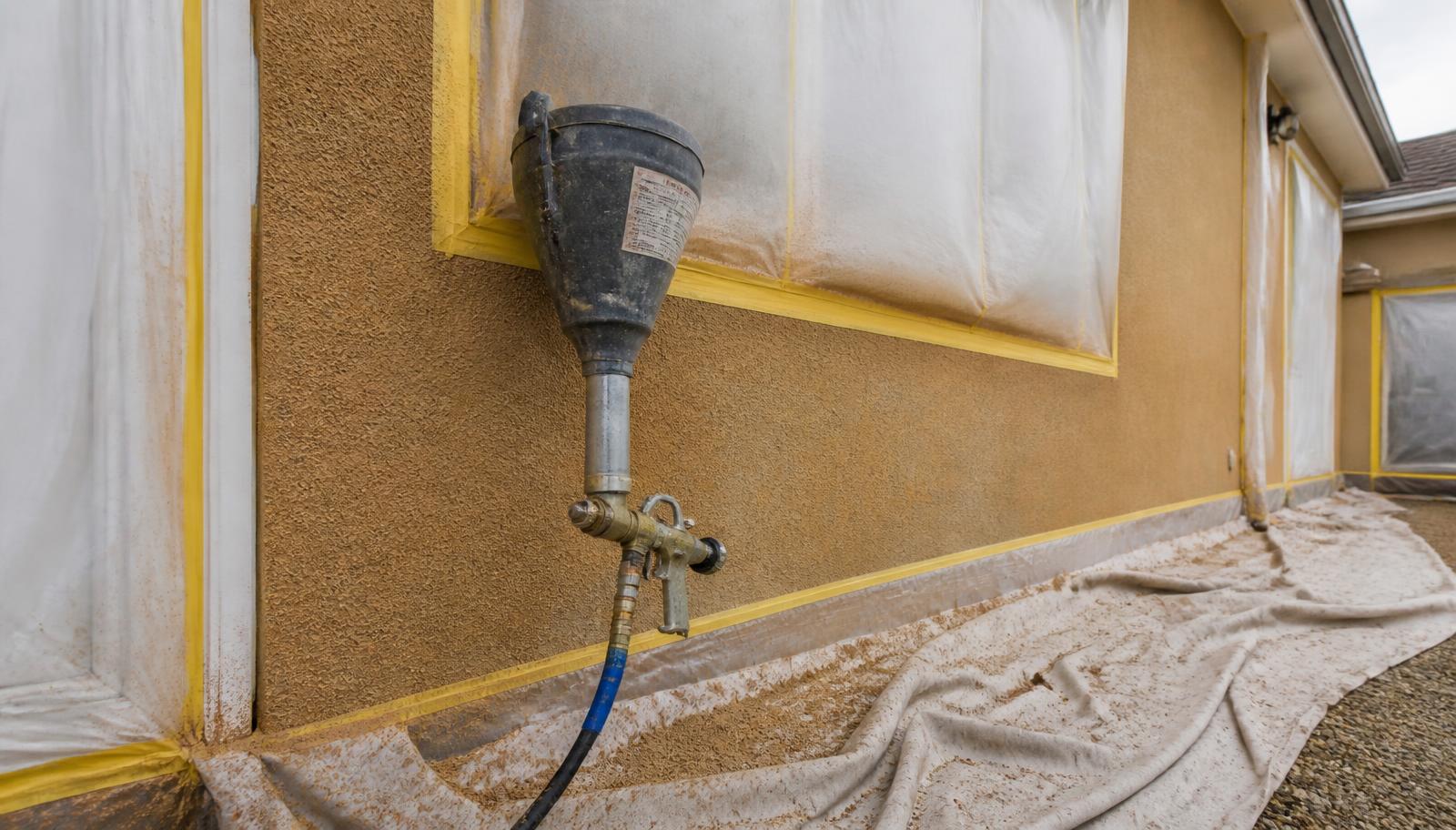
The material is applied with a hopper gun fed by a compressor. The applicator works in even passes, building up coverage rather than flooding one area, so the texture stays consistent across the elevation.
A typical house takes two to four days depending on size, access and weather. Work needs dry conditions and temperatures above roughly 5°C, so UK winter jobs are often weather-delayed.
- Access set up — scaffolding or towers where needed
- Wall cleaned down, usually pressure washed, and left to dry
- Repairs, crack filling and any loose material removed
- Windows, doors, roofs and ground masked and sheeted
- Primer applied to stabilise and even out the substrate
- Two coats of cork sprayed, with drying time between them
- De-mask, reinstate fixings and clean down
What the finish looks and feels like
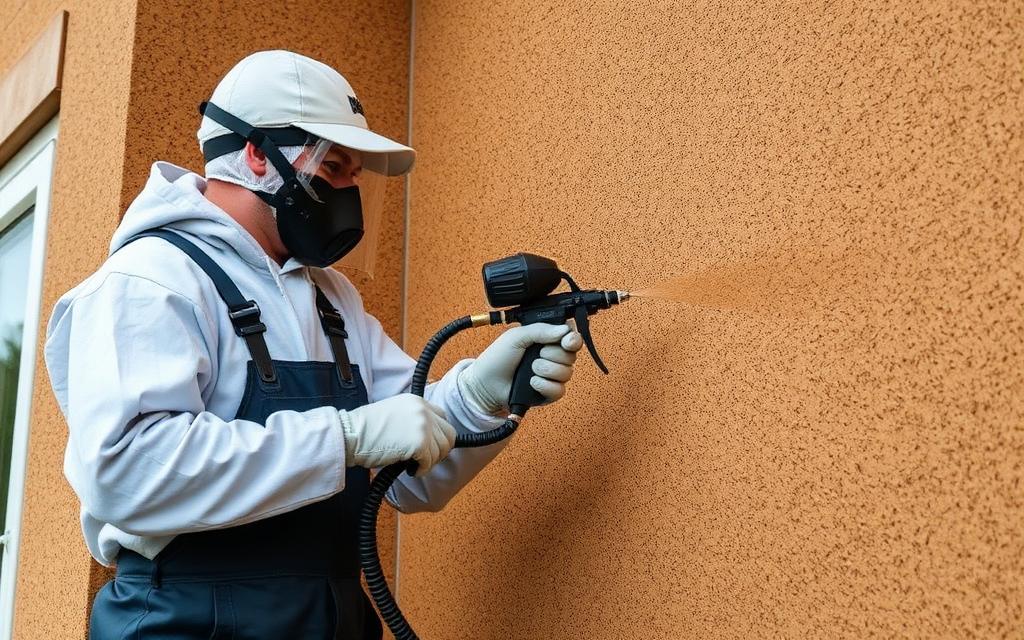
The finished surface is seamless with a fine, granular texture — closer to a suede or sandpaper feel than smooth render. It is slightly soft to the touch and warm rather than cold, because of the air trapped in the cork.
Because it is elastomeric it moves with the building, which is why it is often chosen for walls that have suffered hairline cracking in a rigid render.
Common questions
Is spray cork the same as insulation?+
No. It is a coating a few millimetres thick, so it adds a modest thermal benefit and reduces surface condensation, but it is not comparable to certified external wall insulation and is not usually recognised under UK grant schemes.
How thick is spray cork?+
Usually around 3mm once two coats are built up, though this varies by product and by how the applicator works.
Is it breathable?+
Most spray cork systems are vapour-open, meaning moisture in the wall can escape while liquid water is shed from the surface. Check the specific product's data sheet for its vapour permeability figure.
Can it be applied over pebbledash?+
Yes, provided the pebbledash is sound and well bonded. Loose or hollow areas need cutting out and making good first.
About the author
The Spray Cork Guide editorial team
Independent home improvement research
We research spray cork products, installer practices and published pricing so UK homeowners can weigh up the decision without a sales pitch. We are not an installer and we do not sell spray cork.
Figures on this page are indicative ranges gathered from publicly advertised UK pricing and homeowner reports. Always get written quotes for your own property.
Want a more accurate figure?
Use the calculator for an indicative range for your own wall area, or request quotes from installers covering your area.
Related reading
Keep researching
Costs
Spray cork cost in the UK
What spray cork actually costs in the UK by property type, wall area and surface condition, plus the factors that push a quote up or down.
Verdict
Spray cork advantages and disadvantages
A plain list of the genuine advantages and real disadvantages of spray cork for UK homes, with no sales spin.
Compare
Spray cork vs render
An impartial comparison of spray cork and traditional render across cost, durability, appearance, maintenance, waterproofing, insulation and lifespan.